2026 Bank of America Chicago Marathon Guide & My 2023 Sub-3 Race Recap

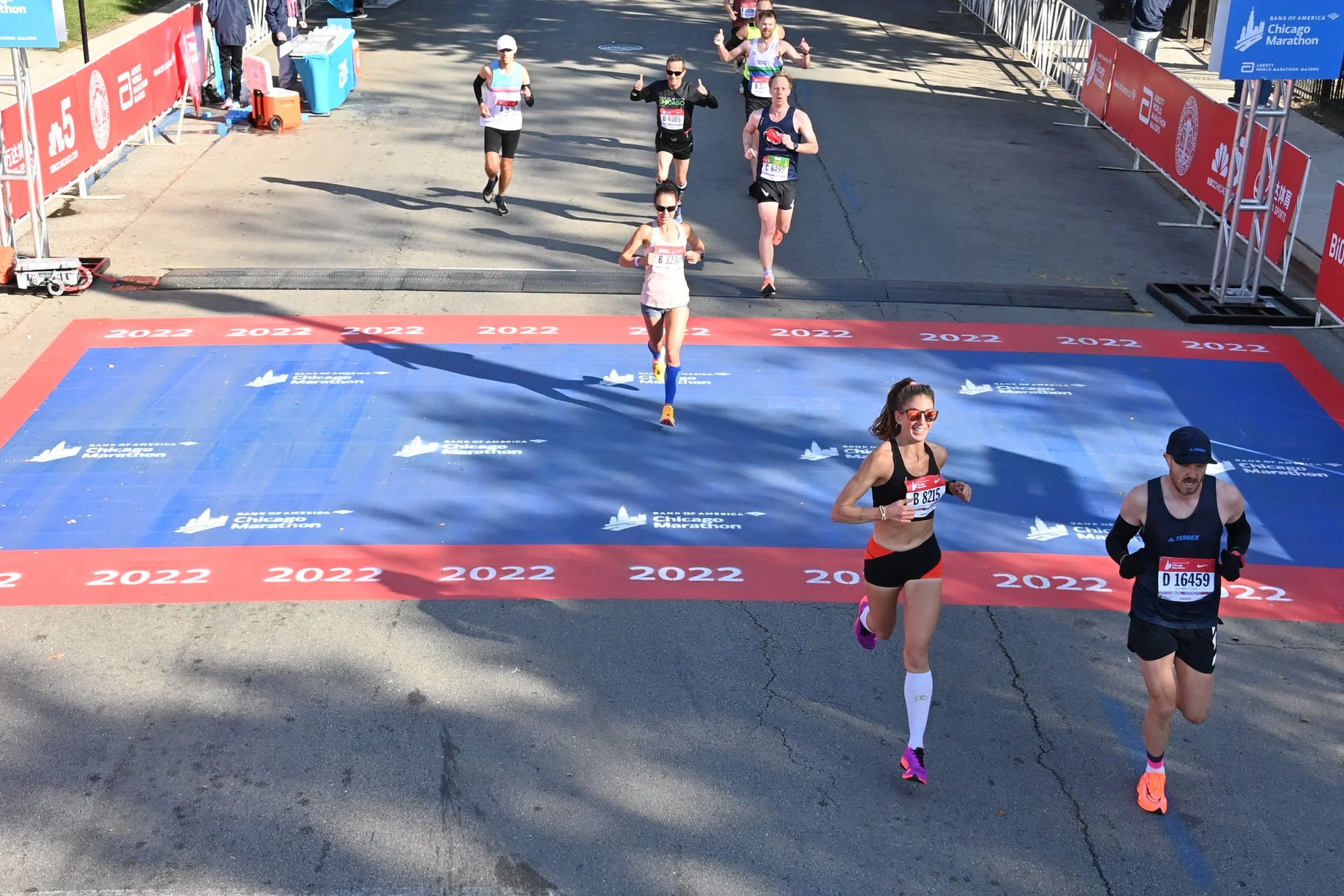
The 2022 Bank of America Chicago Marathon (Yes. I ran this race two years in a row!)
Everything runners need to know about race weekend, corrals, pacers, the course, the expo, hotels, restaurants, and what Chicago taught me about grit, joy, redemption, and belief!
It may be 2026, but with the Bank of America Chicago Marathon on deck this fall, I’ve found myself reflecting on the race I ran there three years ago and the lessons that still stay with me today.
Chicago 2023 was more than my second sub-three-hour marathon. It taught me how powerful it is to stay present, trust my training, race intelligently, and keep believing in myself when the miles get hard. If you’re interested, here is my 2023 Bank of America Chicago Marathon podcast episode on RUNWITHALLI LIVE, where I share every mile of my second experience breaking the sub-three-hour marathon barrier.
So, as runners prepare to return to the streets of Chicago this fall, I’m bringing this recap back with a complete 2026 race-weekend guide to help you arrive informed and ready. Whether you’re racing Chicago, preparing for another fall marathon, or chasing a completely different goal, I hope this reminds you to run the mile you’re in, embrace the discomfort, and keep asking yourself: What if I could fly?! Because when you believe in yourself, you can do a LOT more than ya think!
Here are the top must-knows for 2026. Then, keep reading for the full story of the grit, joy, redemption, and belief behind my 2023 Chicago Marathon.
2026 Chicago Marathon Quick Facts
Marathon Race date: Sunday, October 11, 2026
Start and finish: Grant Park
Course: 26.2 miles through 29 Chicago neighborhoods
Grant Park opens to runners: 5:30 a.m.
Wave 1: Corrals close at 7:20 a.m.; start at 7:35 a.m.
Wave 2: Corrals close at 7:45 a.m.; start at 8:00 a.m.
Wave 3: Corrals close at 8:10 a.m.; start at 8:35 a.m.
Course time limit: 6 hours, 30 minutes—approximately a 15:00-per-mile pace from the time the final runner crosses the start
Official app: Includes live tracking, an interactive course map, bib sharing, pro-athlete information, live coverage, leaderboards, and real-time results
Those times are not suggestions. Grant Park is huge, security takes time, bathroom lines grow, and you still need to reach the correct entrance and corral. The race recommends being inside your corral about 20 minutes before it closes. I’d rather you be settled early than sprinting before you have even crossed the start line.
View the official 2026 participant information
Race-Weekend Schedule
Thursday, October 8
Abbott Health & Fitness Expo: 10:00 a.m.–6:00 p.m.
Friday, October 9
Abbott Health & Fitness Expo: 9:00 a.m.–6:00 p.m.
Official pre-race pasta dinner: Available at Millennium Hall by reservation
Saturday, October 10
Abbott Chicago 5K: 7:30 a.m.
Abbott Health & Fitness Expo: 9:00 a.m.–6:00 p.m.
Official pre-race pasta dinner: Available at Millennium Hall by reservation
Sunday, October 11
Bank of America Chicago Marathon: Wave starts begin at 7:35 a.m.
27th Mile Post-Race Party: 9:30 a.m.–4:00 p.m. at Butler Field in Grant Park
Goose Island post-race celebrations: Five locations throughout the city; the first 312 medal-wearing finishers at each location receive their first 312 beer on the house
The Abbott Chicago 5K is a fun way for family and friends to join race weekend, but marathoners: do not turn Saturday morning into a race unless that is part of your coach-approved plan. Treat it as a short shakeout, keep it controlled, and save your legs for Sunday.
See the official 2026 race-weekend events
The Expo and Packet Pickup Must Knows
The Abbott Health & Fitness Expo is at McCormick Place, North Building, Level 3, Hall B1, at 2301 S. Martin Luther King Drive. It is free and open to the public.
You must pick up your own packet during expo hours. There is no race-day pickup, packets are not mailed, and someone else cannot collect yours. Bring:
Your Packet Pick-up Ticket, digitally or printed. It is scheduled to be emailed on Wednesday, September 30, 2026.
A valid photo ID.
Patience and a plan not to spend five hours walking around the expo the day before your marathon!
Your packet includes your bib and timing device, safety pins, gear-check tag, Nike participant shirt, and participant bag. Check your name, age, address, and gender information when your ticket arrives. If something is incorrect, contact the race office before race weekend.
Large bags and luggage are discouraged, and everyone goes through security screening. If you use rideshare, the race recommends entering McCormick Place–East Building as your drop-off. Public transit is often easier: the Green Line’s Cermak–McCormick Place station is about three blocks away, and the Metra Electric line connects downtown with McCormick Place. If driving, validated parking in Lots A and C is listed at $13 for expo attendees.
Pro coaching tip: Go Thursday or Friday if your travel allows. You’ll have more time to absorb the experience, visit the pace-team booth, buy anything you intentionally planned to purchase, and then get off your feet. Never debut expo-bought shoes, fuel, socks, or gear on race day.
Know Your Corrals Before Race Morning! The 2026 field uses the High Performance corral plus Corrals A–N (there is no Corral I). Wave 1 and Wave 2 assignments are based on accepted qualifying times; Wave 3 assignments are based on anticipated finish time. Final assignments became available in participant accounts on August 20. The faster-corral request deadline passed on August 11, and the race states that no late changes will be considered. You cannot change corrals on race morning, and a pace-team bib or tattoo does not grant access to another corral.
Arrive at your assigned corral roughly 20 minutes before it closes:
Wave 1: 7:20 a.m. closure
Wave 2: 7:45 a.m. closure
Wave 3: 8:10 a.m. closure
Your bib determines where you enter. Screenshot the start map, confirm your gate the night before, and allow far more time than you think you need for security, bathroom stops, gear check, and walking through Grant Park.
Review the official 2026 corral information
Pacers Times, Locations, and Strategy
The official pace team is free, led by experienced marathoners, and covers finish goals from 2 hours and 55 minutes through 6 hours. Stop at the pace-team booth during the expo to ask questions and pick up a temporary pace tattoo. Find your pacers, speak to them about their strategy and ask them where they will be on race day morning, and what they will be wearing so you can flag ‘em down.
Be aware that pacers do not stop for bathrooms and take fluid at each aid station. Big groups can become crowded, especially around the tables, so avoid clipping heels, communicate before moving laterally, and take your bottle or cup farther down the station where it is often less congested.
See the official 2026 pace-team details
The Flat, Fast Course
Chicago starts and finishes in Grant Park and takes runners through 29 neighborhoods, supported by an estimated 1.7 million spectators. Its flat layout has produced seven world records and countless PRs, but “flat” does not mean effortless. The course initially heads north, later moves west, and then travels south before returning toward Grant Park. That layout creates changing wind exposure and many turns. The first mile includes a downtown tunnel, where GPS can become unreliable. Tall buildings can continue to distort your watch, and the official race information warns that your device may show a different distance than the certified course.
How To Race Smart
Use effort and official markers. Turn off auto-lap and manually split at each mile marker if accurate pacing matters to you.
Run the blue line and smooth tangents. Extra weaving adds distance and burns energy.
Protect the opening 5K. Crowds and adrenaline make goal pace feel suspiciously easy. Let people pass.
Expect congestion. Stay patient around early turns and aid stations instead of surging repeatedly.
Break the middle into manageable sections. The halfway point is not the finish; it is where your patience begins to pay you back.
Prepare for the late south-side miles. The energy is incredible, but the field can spread out and the physical work becomes real.
Respect Mount Roosevelt. The short climb up Roosevelt Road near the finish is not a mountain, but at Mile 26 it can feel like one. Expect it, drive the arms, turn left onto Columbus, and GOOOO!
On-Course Aid & Fuel
There are 20 aid stations, approximately one to two miles apart. Each is organized with medical support and toilets first, then lemon-lime Gatorade Endurance, and then water.
Maurten Gel 100: Caffeinated and non-caffeinated options at Miles 12.4 and 18.1; each contains 25 grams of carbohydrate.
Bananas: Aid Stations 16–18, approximately Miles 20.2–23.
Water-refill stations: Before Aid Stations 4, 7, 12, and 16. Approximately Miles 5.7, 10.1, 15.7, and 20.3.
Medical support: At all 20 aid stations, plus two additional course locations and post-finish facilities.
Nothing on that list should become your first experiment on race day. Practice your exact fueling plan during training, carry the products your gut knows, and treat course fuel as planned support or backup. Hydration vests with bladders and hydration backpacks are prohibited; permitted options include approved front-pocket vests, fuel belts, handheld bottles, and soft flasks. Review the official rules before deciding what to carry.
Explore the official course and amenities
My Top Chicago Race Tips
Arrive early and wear throwaway layers. Chicago mornings can be cold, windy, wet, warm, or several of those in one weekend. Check the forecast, dress for the conditions, and bring layers you can discard through the designated collection process.
Do not trust downtown GPS pace. Manual-lap official miles and compare total elapsed time to your pace band.
Write your plan down. Know when you will fuel, drink, take electrolytes if appropriate for you, and adjust for weather. Do not improvise because the crowd makes you feel invincible at Mile 4.
Nothing new on race day. That includes shoes, socks, shorts, breakfast, caffeine dose, gels, and anti-chafe products.
Carry your fuel securely. Know exactly where each gel lives and the order in which you will use it.
Do not bank time. A slightly conservative first 5K gives you options. A reckless first 5K sends you a bill later.
Make a spectator plan. Pick exact sides of the road and landmarks. Not simply “Mile 13.” Cell service may be overloaded.
Use the CTA. Road closures and crowds can make rideshares frustrating. The official transportation page maps stations to viewing points throughout the course.
Plan the finish before the start. Choose a reunion area, decide who carries your phone, and remember that the finish chute is long.
Run the mile you’re in. You do not have to conquer 26.2 miles at once. You only have to execute the step you are taking now.
Go-To Restaurants
Millennium Hall’s official pasta dinner: The lowest-decision option, offered October 9 and 10 near the start in Millennium Park. It is all-you-can-eat and requires a reservation.
Acanto: Italian food on Michigan Avenue across from Millennium Park; convenient for downtown hotels and useful when you want pasta without traveling far.
The Dearborn: A Loop restaurant with a broad menu, helpful for groups with different dietary preferences.
Il Porcellino: A lively Italian-American option in River North. Reserve early and stick with foods you know.
Quartino Ristorante: Shareable Italian dishes in River North, making it easy to build a simple meal, but remember that sharing does not mean sampling every rich dish on the menu the night before your race.
Lou Malnati’s or Pequod’s: This is when to celebrate with Chicago deep dish.
Portillo’s: Italian beef, hot dogs, fries, and cake when you want a classic, casual Chicago reward.
The Gage: Near Millennium Park and convenient after the Grant Park celebration.
Gibsons Italia: Riverfront views and a celebratory steak-and-pasta meal if you want to dress up the occasion.
Goose Island’s official celebration locations: Lizzie McNeill’s, Millennium Hall, Goose Island Taproom, Goose Island Salt Shed Pub, and The Scout Waterhouse + Kitchen.
Reservations for Friday, Saturday, and Sunday should be made like… yesterday Check current hours, menus, dietary accommodations, and cancellation terms directly with each restaurant.
Fun Things to Do Without Wrecking Your Legs
Run or cheer at the Abbott Chicago 5K: Saturday at 7:30 a.m. through downtown.
Visit the expo, but set a time limit: Enjoy the energy, speakers, gear, and brands, then leave before your step count becomes its own endurance event.
Take an architecture river cruise: A seated way to see Chicago while preserving your legs. Choose a time that will not interfere with meals or sleep.
Walk the Chicago Riverwalk or lakefront briefly: Beautiful for loosening up, but save the full sightseeing tour for after the race.
Visit Millennium Park and Cloud Gate: Easy to pair with the expo shuttle/transit or dinner if staying downtown.
Celebrate at the 27th Mile Post-Race Party: Music, food, beverages, and thousands of runners in Butler Field from 9:30 a.m.–4:00 p.m.
Join a brand shakeout or pop-up: Fleet Feet, Nike, Tracksmith, New Balance, Believe in the Run, and other groups commonly host marathon-week events, but schedules can change yearly. Follow the brands and local running stores you care about and confirm that the listing specifically says 2026 before registering.
WARNING! Do not feel like you need to attend everything. The goal of marathon weekend is to arrive at Sunday excited, not exhausted. Pick one or two experiences, keep your normal fueling and sleep routines as intact as possible, and spend the rest of the time with your feet up and body horizontal!
My 2023 Chicago Marathon Race Recap
Race-Day Weekend
Wow. Where do I begin? I arrived in Chicago on Thursday and had the entire weekend to carb-load, decompress, and sit with my own thoughts. Honestly, I’m not the best at sitting with my own thoughts, but it’s essential because a marathon is a LONG FREAKIN’ TIME to live inside your own head.
The day before the race, I could barely think. I ate, and I had a serious case of the taper crazies. My friends, coach, mentors, and team supported me in the best way possible. I love you all. You know who you are. Because of THEM, I was able to stay calm, relaxed, and collected.
I spend my life pouring my energy and expertise into helping others smash their starting and finish lines—and find the best versions of themselves through running. This time, I needed that same support in return. It was the best feeling. ANYWAY, not to go too far off on a tangent! :)
I was fierce. After returning from a minor calf injury that winter, which required me to adjust my goals for the Rock ‘n’ Roll San Diego Marathon I ran that June, I gained confidence in my training and a stronger belief that my best was—and still is—ahead of me. Had it not been for the training block leading up to this race, I wouldn’t have been able to enjoy every step. And that is exactly what I did.
Race Morning
I woke up, ate half a bagel, and sat staring into the mirror while reciting my mantra: “I am a faster runner.”
I headed toward the start in a silent shuffle from my hotel alongside other runners, trying to conserve my energy. I arrived at Grant Park at 5:45 a.m. (SO EARLY), cozying up in two zip-up sweatshirts, sweatpants, a face mask, a hat, gloves, and hand warmers. Did I nail this or WHAT?
Once I reached my corral, I sat beside a tree and embraced the experience minute by minute. I looked around at the other runners and reminded myself how lucky I was to be there—and that I got to run the Chicago Marathon.
The Start
About 30 minutes before the corrals closed at 7:20 a.m., I went to the bathroom and began shedding my layers. I entered my corral at exactly 7:19, and $hit got REAL. I saw my friend Amanda in the starting corral, and we were both frantic! The nerves. The excitement. It was EXHILARATING.
I was laser-focused, with tunnel vision, and promised myself I wouldn’t start too fast—something I usually avoid. We know the GPS can be wonky and unreliable in Chicago, so I told myself I would check my total time after passing the first-mile marker.
The countdown reached five minutes, and I stripped off my final layers. It was my first time racing in briefs. By the way, I’m obsessed. At 7:30, Wave 1 started to ROLL.
Holy crap. It was happening, and I was so freakin’ ready.
Miles 1–3
As we passed through the tunnel during Mile 1, people FLEW by me. I promised myself I’d start close to a 6:55 pace, and I nailed it.
After the first mile, I ran by feel. Once I settled into the pace and got a sense of the runners around me, I picked a few people ahead and stayed near them. I reminded myself not to get carried away simply because I felt SO GOOD during the opening miles. Adrenaline makes it harder to judge your pace and slow yourself down, but I was ON IT.
I took my first non-caffeinated gel at Mile 3. During a marathon, I fuel every 20 minutes. I keep my gels in my sports bra and arrange my salt tablets in the order in which I plan to take them!
Miles 4–6
I settled into the pace and effort, focusing on one step at a time and reminding myself to stay relaxed. I even said aloud, “Stay relaxed, Alli!” I took my second non-caffeinated gel at Mile 5.5. I remember someone yelling, “Only 20 miles to go!” I smiled. How encouraging! But it was also a great reminder to relax, avoid rushing, and focus on the effort required for that mile because that was what I could control.
Miles 7–10
I was cruising. Fully on cruise control. I wasn’t checking my watch, but I was dialed in. I took my third non-caffeinated gel at Mile 8, and before I knew it, we were in the double digits. My mantras were: Stay here. Stay in this step. Focus on this effort. Run the mile you’re in. Whenever my mind wandered toward what lay ahead or what I couldn’t control, I brought it back to the present. It was SO MUCH BETTER for me mentally to stay in the moment, embrace the pack, ride the wave, and send it. You’re probably wondering why I’m celebrating this race as if it were a PR. For me, it was a major win. Heading into my previous marathon training block, I knew exactly what shape I was in. I adjusted my goals because training brings out the truth, and magic may—or may not—happen on race day. The training leading into this build wasn’t as ideal as it had been the year before. I missed PR after PR, yet I still finished within 30 seconds of my 2022 Chicago time. For me, that’s a win. It represents all the training, successful workouts, smart long runs, and the discipline required to race intelligently.
I needed this race as my redemption, just as I needed the second Tracksmith 5K that summer, to prove to myself that I am capable and exactly where I should be. I felt stronger than ever during the final 10K, and now I can’t wait to move beyond my limits and make my stretch goals a reality.
I believe I can achieve crazy things. If I told you out loud what I envision for my future, you might call me LUDICROUS. So I plan to go do it!
Miles 11–14
I saw my friend Lauren around the halfway point, and I needed that energy boost! Isn’t it the BEST when you see your people along the course? So freakin’ COOL.
I finally caught the three-hour pacers and stayed directly behind them. As they had warned us, they were running a few minutes ahead of sub-three-hour pace. They were AMAZING. From their guidance and coaching to the way they talked us through the race mile by mile. You guys are freakin’ bada$$, and thank you for helping us smash our Chicago Marathon!
Miles 13–17 are always mentally challenging for me. It’s that strange stretch when you’re halfway through the marathon, but the real race is only beginning. I need to keep working on those middle miles, and that’s an important takeaway. We all have areas to improve.
I took my fourth gel at Mile 11, along with two salt tablets, then water. By the way, I stopped at every other water station. I took a caffeinated gel at Mile 14.
Miles 15–18
At Mile 17, I took another non-caffeinated gel and two salt tablets, followed by water at the aid station. I was dumping water into my mouth and all over my face. I was a hot mess, but that was the last thing I cared about.
Push it. Push through it.
I remember hearing an announcer say, “The world record was just broken!” Twenty-three-year-old Kenyan Kelvin Kiptum (R.I.P.) had shattered the world record with a scorching time of 2:00:35. HOLY FREAKIN’ COW! Talk about hearing something inspirational just as you enter the pain cave of a marathon. It was EXACTLY what I needed at Mile 18.
Miles 19–21

I took another caffeinated gel and one salt tablet at Mile 20.5. The real race had begun. I kept telling myself, “Focus. Run this mile. Focus on your effort, Alli.” As the effort became harder, I paid attention to how I responded and whether I could maintain clarity deep inside the pain cave.
I was riding my absolute limit in that moment. I had to control that effort throughout most of a marathon. I did exactly that. I committed to the effort with every step, stayed present, and ran the mile I was in.
Mile 22 to the Beginning of Mile 25
At Mile 23, I took another non-caffeinated gel, half of a caffeinated gel, and one salt tablet, followed by water.
The crowds were roaring here, unlike the previous year. I was in awe, completely focused, and I felt GOOD. I felt stronger than I ever had during the final 10K of a marathon. My legs didn’t feel wobbly. I felt strong as an ox. That had been a long-term goal: to reach the final 10K feeling strong while holding my pace.
It’s going to hurt. Accept it. Lean into it. Embrace it. As Kipchoge shared during the Breaking 2 project, success lies on the other side of pain. That idea couldn’t have felt more accurate. Do the best you can in every moment. That applies to both running and life.
Miles 25–26.2
The pacers told us, “If you’re going ahead, go now.” And I fully f*cking SENT IT! I took one final caffeinated gel. When I saw the “1 Mile to Go” sign, I reminded myself of my training. All those fall tempo runs and their final miles, when I would tell myself, “You’re almost done. The hardest part is behind you. Just run.”
IT’S ONLY ONE MILE! So that’s what I did. I pressed the gas because I could. I asked myself, “WHAT IF I COULD FLY?” Shout-out to my athlete, Shelley Joynt, for that one!
I saw the 800-meter marker. It was exhilarating. Then I saw the 400-meter marker as I approached the final climb up Roosevelt Road. BOOM! I turned left for the last 200 meters and saw the finish line. I BOLTED across it, stomped on the finish line, and said, “F-YES! I JUST DID THAT!”
This year, my time appeared immediately. That instant gratification was mine. Although I ran the race for myself, my family, my athletes, and every runner I hope to inspire to chase aggressive goals and do hard things, I needed this one for me. It was redemption—and a reminder that I’m a bada$$ who can do hard things.
The clock is just the clock, but after 26.2 miles of booking it, it felt pretty damn good to see all my training and hard work reflected right before my eyes.
Support Corner
If it weren’t for one of my former athletes, who became my business coach and mentor, Jennifer Chambers, I wouldn’t be performing the way I am today. This woman is a GODDESS, and she has helped me navigate ALL THE THINGS. Jen, I am forever grateful for you.
It takes a village to chase big goals. No one achieves great things alone. Not even Kipchoge or Kiptum. ❤️
To my athletes: You always have (and will continue to) inspire me more than you know. I might be your coach, but you give me wings to lead and soar. I know the other RWA coaches can speak to this too!
To my family: I love you, and thank you for always supporting my crazy running goals!
To my friends: I am loyal to you, I freakin’ love you, and I am grateful for every one of you. You know who you are!
To the Chicago Marathon: Thank you for making this race unforgettable.
Finally, THANK YOU, you fantastic human, for reading this.
After the Finish
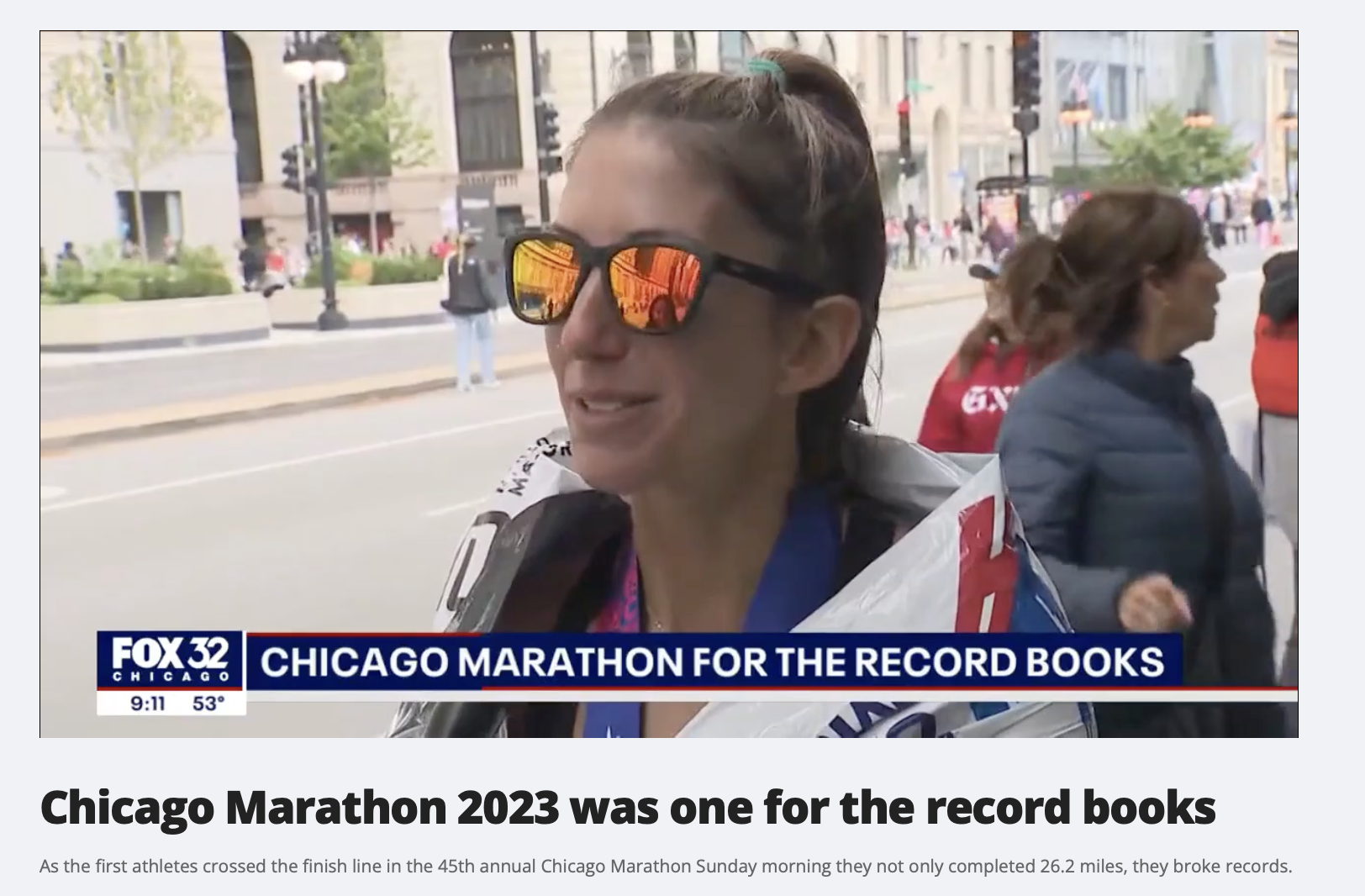
Fox 32 News Interview After the 2023 Bank of America Chicago Marathon
I walked three miles back to my hotel after the race because I didn’t run with my phone or check a bag. Along the way, a reporter from Fox 32 News interviewed me, and I was speechless. The reporter stopped me and asked if I had 30 seconds to describe the race and the entire experience.
All I could say was, “It was incredible. The crowds were unlike anything I’ve ever experienced, and I’m still taking it all in.”
And I still am. Walking back to my hotel in briefs, wrapped in my Chicago Marathon blanket, was an experience, to say the least. So many people congratulated me, and I arrived in time to cheer for other marathoners as they chased their own aggressive goals and worked toward their finish lines. The course passed directly by my hotel at Mile 22, and supporting those runners was the BEST part.
Nothing brings me more joy than experiencing this sport from both sides. As a runner, a cheerleader, and a coach. Giving back the energy that others offered me throughout my training and the marathon fills my cup. This is who I am, and it’s what I love.
When I accomplish my own goals and inspire myself to do hard things, I feel even more motivated to help others do the same for themselves wholeheartedly.
Running brings people from all walks of life, each with a different WHY, together. Especially during a marathon. It’s f*cking incredible. Few things bring me more joy than being part of the running community.
Chicago 2023 was unforgettable. I promised I would return stronger, fiercer, and faster, and since then, I have! I just haven’t run it back in Chicago…yet!
This fall, we have some incredible RunWithAlli® athletes preparing for the big dance, and I cannot wait to cheer them on as they chase their goals. As for me, I’ll be back on those streets again one day—and hopefully very soon!
Whatever lies ahead for you. A fall marathon, an upcoming race, or a brand-new training block, remember that consistent hard work pays off. Follow a properly periodized plan, stay patient, and keep your training balanced, challenging, and FUN!
Keep showing up. Your next breakthrough may be closer than you think!
Ready to Chase Your Next Starting Line?
If you’re preparing for Chicago or any goal from the mile to the marathon, you do not have to figure out your training, pacing, fueling, and race strategy alone. RunWithAlli® coaching is personalized to your experience, life, and goals so you can arrive at the start line confident, prepared, and ready to see what is possible.
Learn more about RunWithAlli® coaching
Official 2026 Resources
Race logistics and event offerings can change. Always defer to official race communications, the 2026 participant guide, your participant account, and race-day instructions.
The First Woman to Run a Marathon Fueled on Nothing. Here's What Changed.
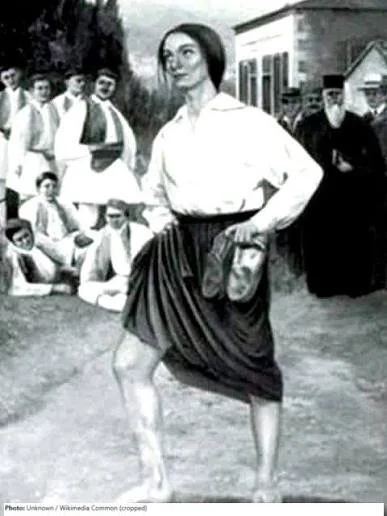
Stamata Revithi
A widow in a heavy skirt, running 40km on foot with no plan, no aid stations, and probably nothing more than bread in her stomach because the Olympics didn't think women's bodies could handle the distance. Stamata Revithi ran the 1896 Olympic marathon route unofficially after women were excluded from the first modern Olympic Games. The day after the men's race, she completed the Marathon-to-Athens route in approximately 5.5 hours, but was not allowed to enter the Olympic stadium. Her remarkable run received little recognition. The run remained an overlooked chapter in women's running history for decades!
Stamata Revithi ran the 1896 Olympic marathon route unofficially, one day after the men's race, after women were excluded from competing in the first modern Olympic Games. She completed the Marathon-to-Athens route in roughly 5.5 hours and secured signed statements from local officials along the route to verify her time. She was not allowed to enter the Olympic stadium at the finish, and her run went largely unrecognized for decades.
There's no record of any nutrition plan behind that run, because there wasn't one. Revithi was impoverished, breastfeeding a 17-month-old son, and running with essentially nothing in her system. She hoped a strong showing would bring her enough publicity to land a job and support her child. She ran the men’s only route to Athens fueled by little more than determination.
Violet Stewart Louisa Piercy: 37 Years, One Uterus Myth, and a Baby Ruth Bar
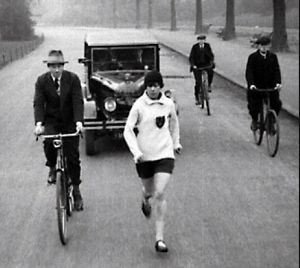
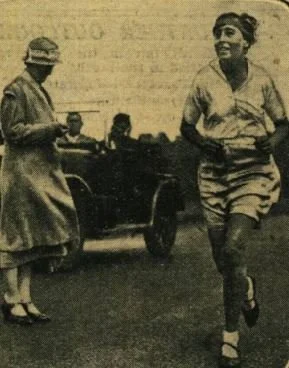
Violet Stewart Louisa Piercy, born in 1889 in Croydon, ran from Windsor to London on October 3, 1926, in 3 hours, 40 minutes, and 22 seconds on the Polytechnic Marathon course, one of the first regularly run marathons in Europe. She became the first British woman recognized for a marathon time, and her mark stood for 37 years, largely on grit rather than fuel. There’s no record she had any real strategy for eating or hydrating across that distance.
She kept going back for more. In 1928 she attempted the London marathon again and stopped at 20 miles due to heat exhaustion. In 1933, she completed 22 miles in 3 hours 45 minutes through sleet and rain, in a run approved by the Women's Amateur Athletic Association.
Long-distance running was actively discouraged for women during this era, and officially banned in competition. The prevailing belief, reinforced by reports of exhausted runners collapsing in the 800m at the 1928 Olympics, was that women's bodies weren't built for endurance, and some went so far as to claim distance running could damage a woman's reproductive organs. It's wild by today's standards, but it shaped policy. The Women's Amateur Athletic Association limited women's races to 1,000 meters or less.
Piercy ran anyway. In 1936, at 46 years old, she was finally permitted to run the Polytechnic Marathon itself, on the condition she start ahead of the male field as the only woman entered. She finished in 4 hours 25 minutes. Not competing against the men, she said, but proving a woman could stick out the distance. After World War II she moved frequently and faced hardship, she died in 1972 after a brain hemorrhage. She remains one of the pioneers of women's distance running.
New Records
Marie-Louise Ledru, a French athlete, completed the marathon distance at the Tour de Paris Marathon on September 19, 1918, a run some statisticians now credit as the actual first female marathon finish. Arlene Pieper became the first woman to officially finish a sanctioned marathon, the Pikes Peak Marathon, in 1959.
At the 1963 Western Hemisphere Marathon, Merry Lepper and her training partner Lyn Carman hid behind a hedge near the start line and slipped into the field once the gun went off. Lepper finished in 3:37:07, breaking Piercy's 37-year-old mark. She did it running on a Baby Ruth candy bar, having been in too much of a rush that morning to eat breakfast!
Dale Greig broke 3:30 for the first time in 1964, running 3:27:45. Just months later, Mildred Sampson posted a time of 3:19:33, though record-keeping from this period is spotty enough that historians still debate its accuracy. In May 1967, Maureen Wilton, just 13 years old, ran 3:15:23 in Toronto, becoming one of the youngest world-record holders in any sport. Four months later, Anni Pede-Erdkamp took the mark down to 3:07:27!
The Diner Breakfast That Fueled a Revolution
In 1966, Roberta Gibb hid in the bushes near the start line of the Boston Marathon and became the first woman to run and finish the course, in 3 hours, 21 minutes, and 40 seconds, entirely unofficially. She'd return to run it again, still unofficially, in 1967 and 1968.
A year after Gibb's run, Kathrine Switzer became the first woman to run Boston with an official race number. Nothing in the rulebook explicitly barred women, so she registered as "K.V. Switzer" and toed the line on April 19, 1967. That freezing morning, her training group ate a huge cold-weather breakfast before heading to the start. This included bacon, eggs, pancakes, juice, coffee, milk, extra toast. It wasn't a fueling strategy. It was just what was in front of them on a cold morning before 26.2 miles.
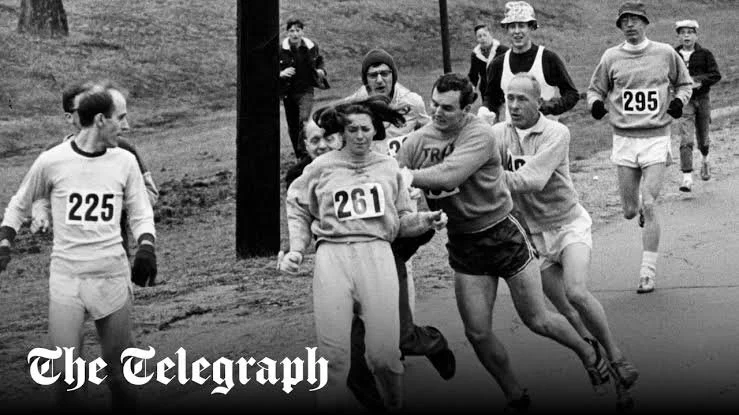
A few miles in, race director Jock Semple grabbed Switzer and tried to physically pull her off the course. Her boyfriend body-checked him out of the way. She finished the race anyway, and the photo of the confrontation became one of the defining images of the women's running movement. Bib 261 is still remembered today.
At age 70, Switzer ran Boston again. By then her approach to fueling had changed almost as much as the sport around her. She’s said she doesn't count calories or follow trends, joking that her diet is a “SEE-FOOD-DIET” as if she sees food, she eats it. She has mentioned leaning more toward protein and fresh produce at 70 than she did as a younger runner, when she had no nutrition plan at all.
Marathon Fueling Today
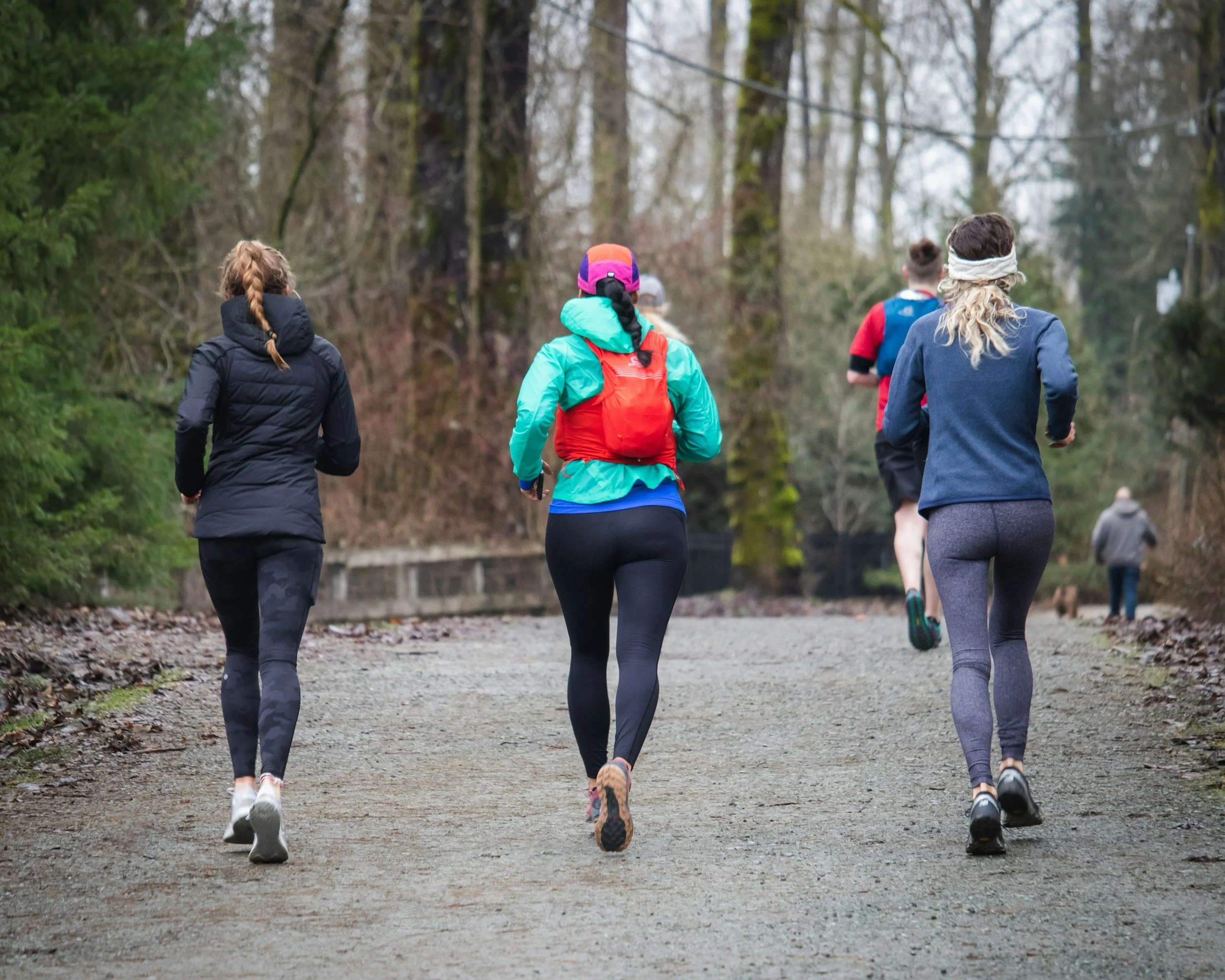
Compare all of this to a modern-day distance training plan, with nutrition integrated from the very beginning. Today’s marathoners don’t simply train their legs and lungs. They train their ability to fuel, hydrate, and recover! Heck yes! Runners should increase carbohydrate intake in the days leading up to a marathon, practice taking gels or other carbohydrate sources during long runs, and develop a hydration strategy that can be adjusted based on individual sweat rates and environmental conditions. During a marathon, fueling is often planned at regular intervals. I recommend refueling frequently (every 25–40 minutes) rather than waiting until the body is completely depleted.
When we look at the history of women’s distance running, the women who helped establish women’s marathoning were competing when many of the nutritional strategies that are now considered fundamental to endurance performance did not exist. There was no widespread concept of training the gut to tolerate carbs during a marathon, no individualized sweat testing to determine fluid and electrolyte needs and losses. There were no sports nutritionists personalizing nutrition and hydration strategies for these runners. These athletes were pushing the boundaries of what women were believed to be physically capable of while operating with an extraordinarily limited understanding of how to fuel that effort.
Distance running has helped drive the evolution of sports nutrition ever since. The sport has shifted from asking how far and how fast someone can run to asking how well she can fuel the work it takes to get there. Modern female distance runners can individualize carbohydrate intake, hydration, electrolytes, and recovery based on training demands and their own physiology, and sports nutritionists can help runners train the gut, dial in hydration, and figure out exactly what fuel works for them.
Takeaway
The women who built this sport's history didn't have smartwatches, pacers, gels, or a coach checking their fueling windows. They had determination and almost no information, and they still went the distance, which, honestly, was very dangerous. Today runners have the opposite problem. Way too much conflicting advice online. That also means we finally have the tools to actually personalize a plan, something the first women in this sport never had. Now we can actually personalize and PLAN!
If Stamata Revithi could run 26 miles on empty, what's your excuse for skipping your fueling plan on race day?
What's your go-to marathon fuel? Drop it in the comments below! I'd LOVE to learn more about what's carried you through your own 26.2 journey!
Why Your VDOT Doesn't Predict Your Marathon Time (And Why That's Actually Good News)
Why Your VDOT Doesn't Predict Your Marathon Time (And Why That's Actually Good News)
You run a 24-minute 5K.
According to the VDOT tables, you're theoretically capable of running a sub-4-hour marathon.
Then race day comes.
Mile 18 hits.
Everything falls apart.
What happened?!
Was the VDOT chart wrong?!
Not exactly.
Let's talk about one of the biggest misconceptions runners have about Jack Daniels' VDOT system, and how understanding it can make you a much smarter athlete!
First Things First: Stop Chasing Every Piece of Running Advice
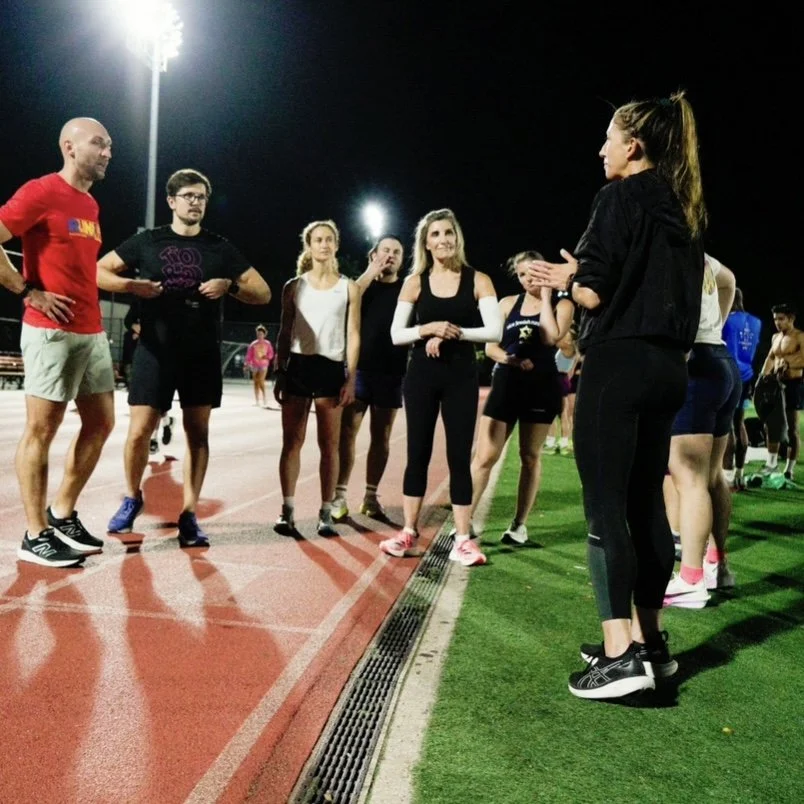
Every athlete responds differently to training. Context always matters more than a generic training tip.
One-size-fits-all advice is exactly what it sounds like.
It's important to recognize that social media provides general information. Not guidance tailored to your individual needs. With an overwhelming amount of information available online, it's easy to get distracted by every new trend or "shiny object." Instead, trust your training plan, consult with your coach, and lean on your training partners when questions arise.
Remember, your training history, nutrition, recovery, work demands, life stress, sleep, and countless other factors all influence how you adapt to training. They also determine when your training may need to be adjusted to optimize performance while reducing the risk of injury or burnout.
That's why I coach using VDOT, but always through the lens of the individual athlete. Data is valuable, but context is everything. It's imperative to coach the person first and the athlete second.
What VDOT Actually Measures
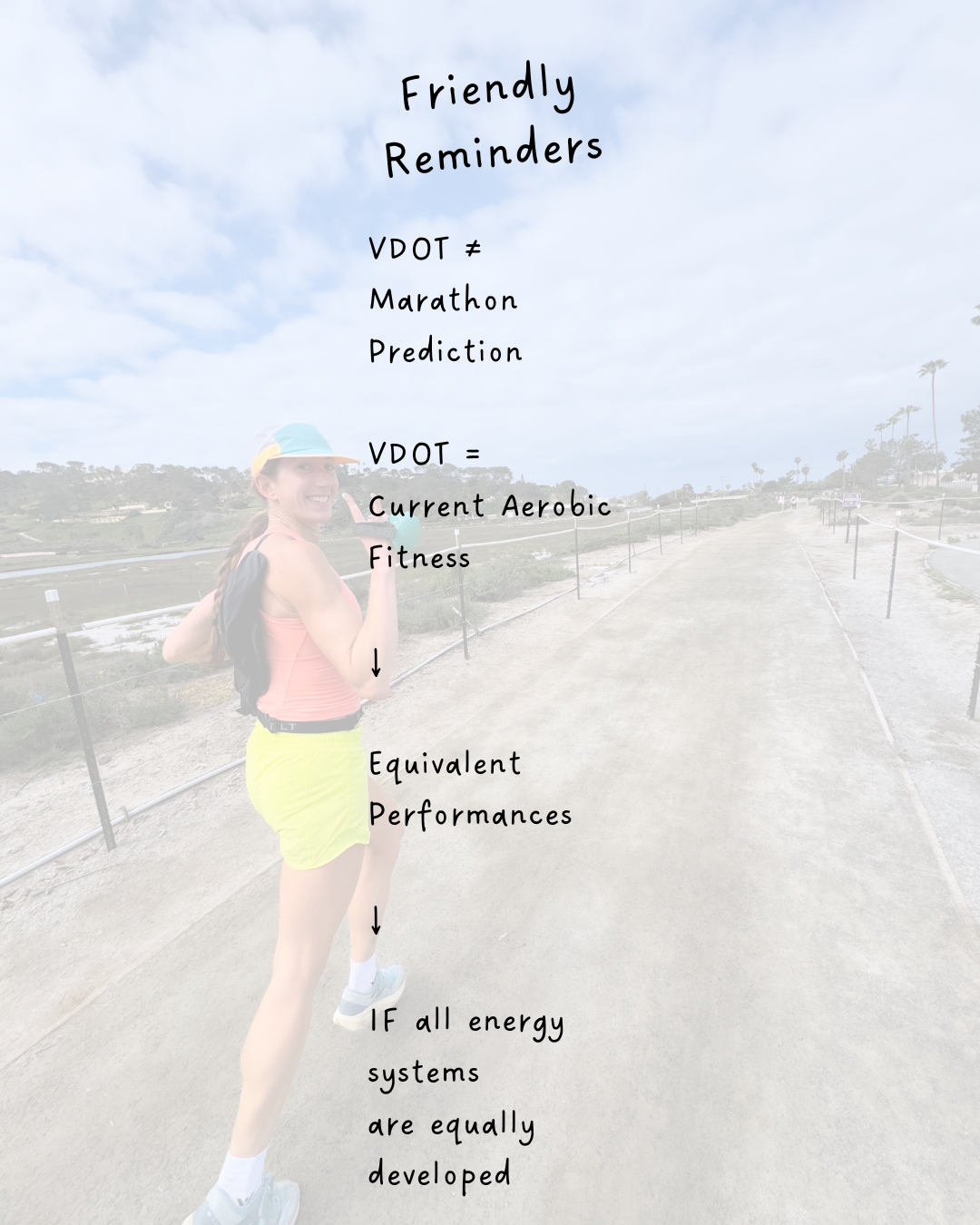
A common misconception about the Jack Daniels VDOT tables is that the chart predicts what you will run at every distance. It doesn't! Hear me out.
The chart is really saying that if your aerobic fitness is at a certain level, these performances are theoretically equivalent if ALL systems are equally developed. By systems, I mean your energy systems (there are three), and it's nearly impossible to train all of them equally at the same time. That's why we focus on 5K-specific training during certain times of the year and marathon-specific training during others.
Almost nobody has equally developed systems, and that's okay!
Remember: a marathon is not an extended 5K. It is COMPLETELY different, and so is the training. So train for the race you’re actually running.
VDOT is NOT predicting what you'll run. It's showing what performances could be equivalent if every energy system were equally developed.
The Phosphagen, Glycolytic, and Aerobic systems produce ATP, the energy your muscles use. They work together and shift continuously based on run intensity and duration.
Activities up to 10 seconds primarily rely on the Phosphagen System. Efforts from 10 seconds to about 2 minutes primarily use the Glycolytic System. Activities longer than 2 minutes rely predominantly on the Aerobic System, fueled by carbohydrates, fats, and, to a lesser extent, proteins.
Train all three energy systems because they're interconnected. While every run uses all three to some degree, different workouts emphasize one system more than the others. A well-rounded training plan develops each system at the right time to help you become a stronger, faster, and more efficient runner.
Why the Marathon Is Completely Different
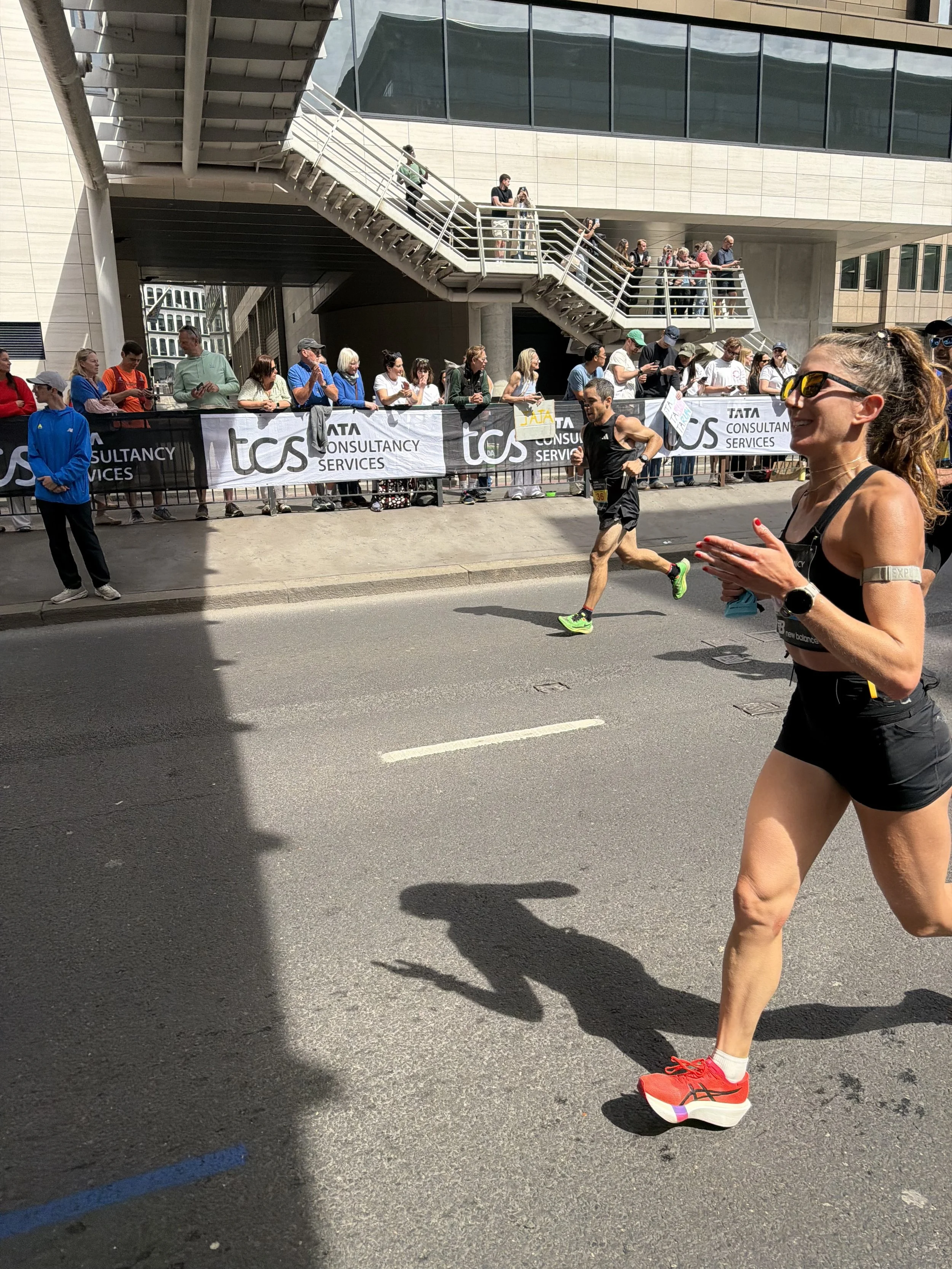
Marathon success depends on much more than speed. Fueling, pacing, hydration, durability, and recovery all matter.
Durability. Your body needs to get acclimated over time (this can be year over year or over months) to tolerate the demands of running for hours at a time. It’s the ability to maintain the same power output or effort in that last 10K of the marathon distance. This is important for long-term health and injury-prevention as well. For example, a durable marathon runner could look like someone who has trained their body and stomach to use fat and carbohydrates as fuel, so that later in the race they avoid hitting the wall, or “bonking,” by training both metabolic systems throughout training. Durability is built through strength, fatigue resistance, and nutrition throughout training. This is why periodizing your training is crucial to your success as an athlete and durability as one. Building your base while working on speed endurance before heavying up on the aerobic work and marathon-specific work 20-16 weeks out from a marathon, since that specificity (long runs, long run workouts with MP time on feet) is important closer to the marathon, but not for weeks on end throughout the year before it. Year after year, with consistency and proper periodization, challenging your body and knowing when to recover and back off builds durability.
Glycogen. Practice fueling during most of your runs (Not just long runs) with fuel sources of choice. My go-to is Neversecond C30 Citrus or Passion Fruit for a marathon, with its science-backed, tested 2:1 glucose-to-fructose ratio, which means GI issues won’t be a concern during any training run, especially on race day! Additionally, teaching your body to use fat as fuel while sparing glycogen during longer runs will allow you to use two different fuel sources during the marathon. This can also be manipulated by diet and the timing of consuming different macronutrients around your long runs.
Fueling. A non-negotiable for any run of any distance. Eating frequently (5-6x a day) around your runs with carbohydrate, proteins, and fats, avoiding fasted workouts or runs, and eating within a 15-60’ window after your runs will allow you to recover better, optimize performance and training adaptations, train your stomach (& body and brain) to use fuel efficiently to optimize performance in and out of training and over time, keep you from getting injured and burning out!
Muscular endurance. Through proper strength training, cross-training, long runs, and running on varied terrain throughout training, you will allow your muscles to adapt to the stress of the long run, which is ultimately the marathon, with the ability to hold form and pace (or effort) that lasts 10K, similar to durability mentioned above.
Time on feet. Instead of focusing on distance, focusing on time on feet is more conducive to your success as a marathon runner, since the marathon is essentially time on feet, like any long run! For example, take two runners who each run between 7 and 10 hours a week. One runner may cover 35-40 miles a week, whereas another may cover twice that amount, but the constant here is the time spent. The range of efforts from Zone 1 to Zone 5 will dictate how much volume you run within those hours, and this varies for each individual. A sub-4-hour marathon runner’s Zone 2 paces might look different than a 3-hour 30-minute marathoner, and the workout paces will definitely look different, but worrying about how much time you spent to get your body used to the stress of being on your feet for hours on end throughout the week is critical for the marathon, and a confidence builder, too!
Pacing. Learning to pace and how to dial it back in the first half of a marathon is a true skill that should be practiced at different effort levels during different runs and workouts in training. And it’s hard! When in doubt, slow it down, and practice running without looking at the watch at an effort that feels relative to the prescribed pace in your training. The more you practice, the better you’ll get with this. Understanding how your body feels at different paces (or efforts) is crucial as well. The more you learn to run by feel, the more you’ll learn how to pace yourself, best knowing when to dial it back and push, having that experience from your training! And it will change year after year, but know what to expect!
The marathon demands:
Long-run adaptations
Fueling strategy
Hydration practice
Mental resilience
Recovery
Aerobic durability
Race execution
This is why it’s a different event compared to a half marathon, 10K, or 5K! Expect to practice all of these during your training.
My Own Experience
I improved my marathon by 19 minutes, but not because I was marathon training year-round. I started by:
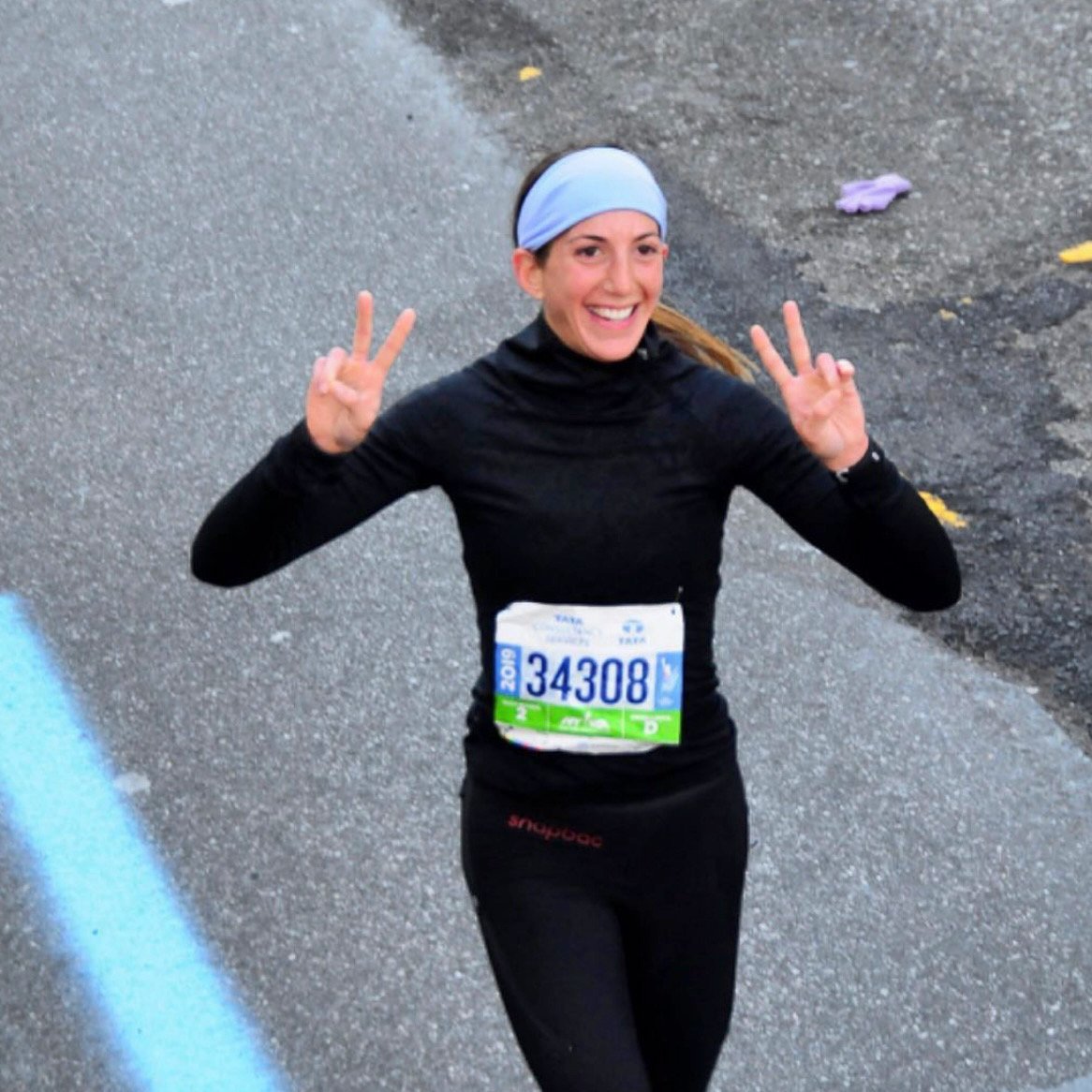
Chasing a faster 5K. After running the TCS NYC Marathon in 2019 and plateauing at a 3-hour-22-minute PR over four consecutive marathons, I wanted to chase a faster one. Since I took up running as an adult, chasing half and full marathons first without learning how to run fast or race faster over shorter distances, I was set on improving. So I did it. I adjusted my training with the guidance of my coach at the time to get faster at the 5K distance while working on my running technique, once mentored by Dr. Michael Yessis, and learning how to run fast. A skill. I dropped my 5K PR from 19:37 minutes to 18:18 in a little under 1.5 years, and I still have work to do! This didn’t directly impact my marathon time, but, when it came time for the marathon training block to begin, I had a greater ability to holder a higher fraction of my 5K mile race pace (or a faster speed) than I had when I ran a 3 hour and 22 minute marathon for the fourth consecutive time in a row in the marathon distance at the 2019 TCS New York City Marathon. After COVID hit, and I truly periodized my training, incorporated speed work, strength, and lots of cross-training in a MUCH more personalized program, I ran a 3 hour and 2 minute marathon at my first attempt to break three hours in the marathon distance at the 2021 Rock ’n’ Roll San Diego Marathon before breaking 3 hours at the Bank of America 2022 Chicago Marathon in 2022.
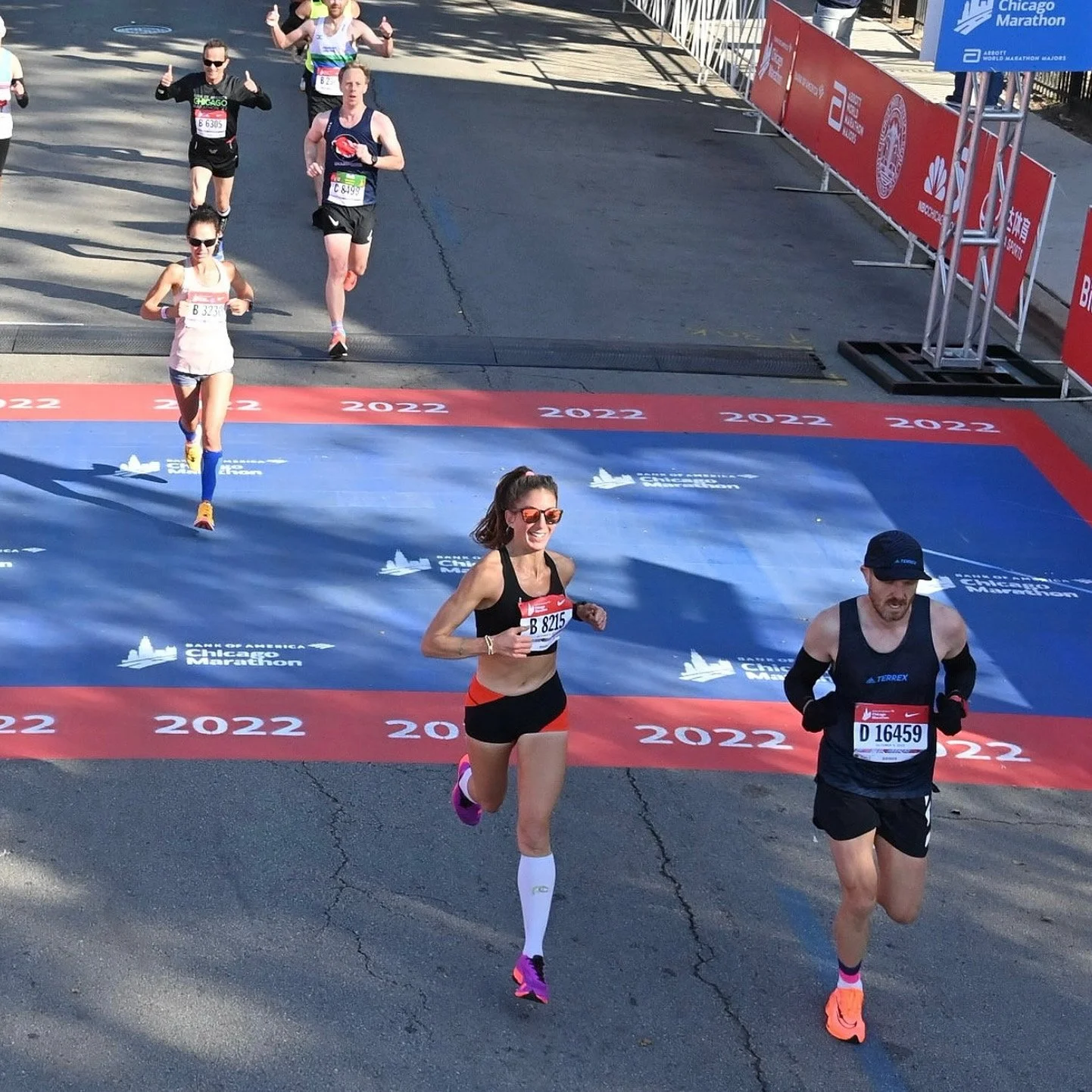
Becoming stronger.I incorporated strength training, strides, and hill sprints regularly into my training around my runs, leaning heavily into strength and its forms during speed blocks usually during the summertime before my marathon build.
Improving economy & technique. I focused on fine-tuning my running technique, practicing my knee drive, pawback, and ankle extension at push-off to enhance my running economy and form, improving my ability to run faster and more effortlessly with better control.
Then, building for my marathon. I focused on marathon-specific runs, runs at goal-marathon pace, and felt stronger, with goal-marathon pace feeling a bit easier than I had expected it to feel, while also having more control over my body throughout my long runs in training and not feeling completely wiped at the end of them. I attribute a lot of that to nutrition as well, not just training and recovery between sessions!
Why Some Runners "Outperform" Their VDOT
Example 1
Runner A
Can run a 25-minute 5K
Fades after 15 miles
This runner likely needs:
Fueling
Endurance
Pacing
Durability
NOT more speed.
Example 2
Runner B
Can barely run a fast mile. Yet crushes marathons.
This running has excellent:
Aerobic development
Efficiency
Endurance
I can relate to Runner B a lot, as I felt confident in the marathon before running a faster mile or 5K. Leaning into your strengths AND weaknesses at the right time throughout the year to work on speed (or endurance, fueling, pacing, and durability) is different for everyone, which is why cookie-cutter programs are not helpful in getting what they need when these variables are at play. Working with a coach who gets you will help you to level up.
The Marathon Exposes Weaknesses
The marathon punishes weaknesses.
Short races let you get away with:
Poor fueling. You don’t NEED to fuel for a half-marathon (and under), although it may help. Your body will physically run out of nutrients after about 90-120 minutes of continuous running or marathon running/walking.
Poor pacing. Consistent pacing, especially when practiced this way during training, always wins. Pacing differently in a race than you’ve practiced during training will cost you potential, burning through glycogen way too quickly, outrunning your fitness (or trying), and leading you to slow down way earlier than you’d like.
Lack of durability. There is less emphasis on holding form for shorter distances than in a marathon because they are shorter and, usually, we’re not out there for hours on end on our feet. For example, in a 5K, your body doesn’t experience glycogen depletion since it’s both anaerobic and aerobic, and you can run closer to your max effort with your form falling off!
The marathon doesn't.
Why I Recommend Periodizing Your Year
Speed & Strength (Anywhere during your preparation phase, which can be as little as 12 weeks to as long as you want, but giving yourself at least 20 weeks to heavy-up on marathon-specific training more or less). Focus on specific training for the following distances in this order:
↓
5K/10K
↓
Half Marathon
↓
Marathon
Use a reverse linear periodization model (which this follows), focusing on intensity and speed before heavying up on volume and slower, longer tempos (or less intense quality sessions) in your marathon build. This helps to prevent burnout, incorprate variety so you don’t plateau fitness-wise, and teaches you how to touch different energy systems and gears throughout different parts of the year. All which are conducive to when that marathon build starts! When you are in your best 5K shape, and the marathon pace chart equivalent says what you can run in the marathon, you still need to build the endurance and specificity for the marathon distance. This can take years, a different strategy than you‘ve done before, it’s very theoretical, and there is something that works for everyone.
This is why the marathon is my favorite distance. It takes into consideration someone’s training history, physiology, for women, the menstrual cycle, strengths and weaknesses, nutrition and hydration, time on feet, durability, mental capacity, and so much more. There are so many ways to get creative with marathon training by incorporating run commuting or brick workouts into this specific block. This could make training doable for the Dad with a full-time job and three kids, or the busy Mom carpooling her kids all over before and after school and on weekends. But overall, consistency is the game’s name, and with that said, missing one run, or a week in a marathon build won’t make or break your marathon race day, regardless of what that build looks like, or how fast you plan to run the marathon!
My 5K to Marathon Training Plans Can be Found Here!
The Marathon Is Usually the LAST Distance to Improve
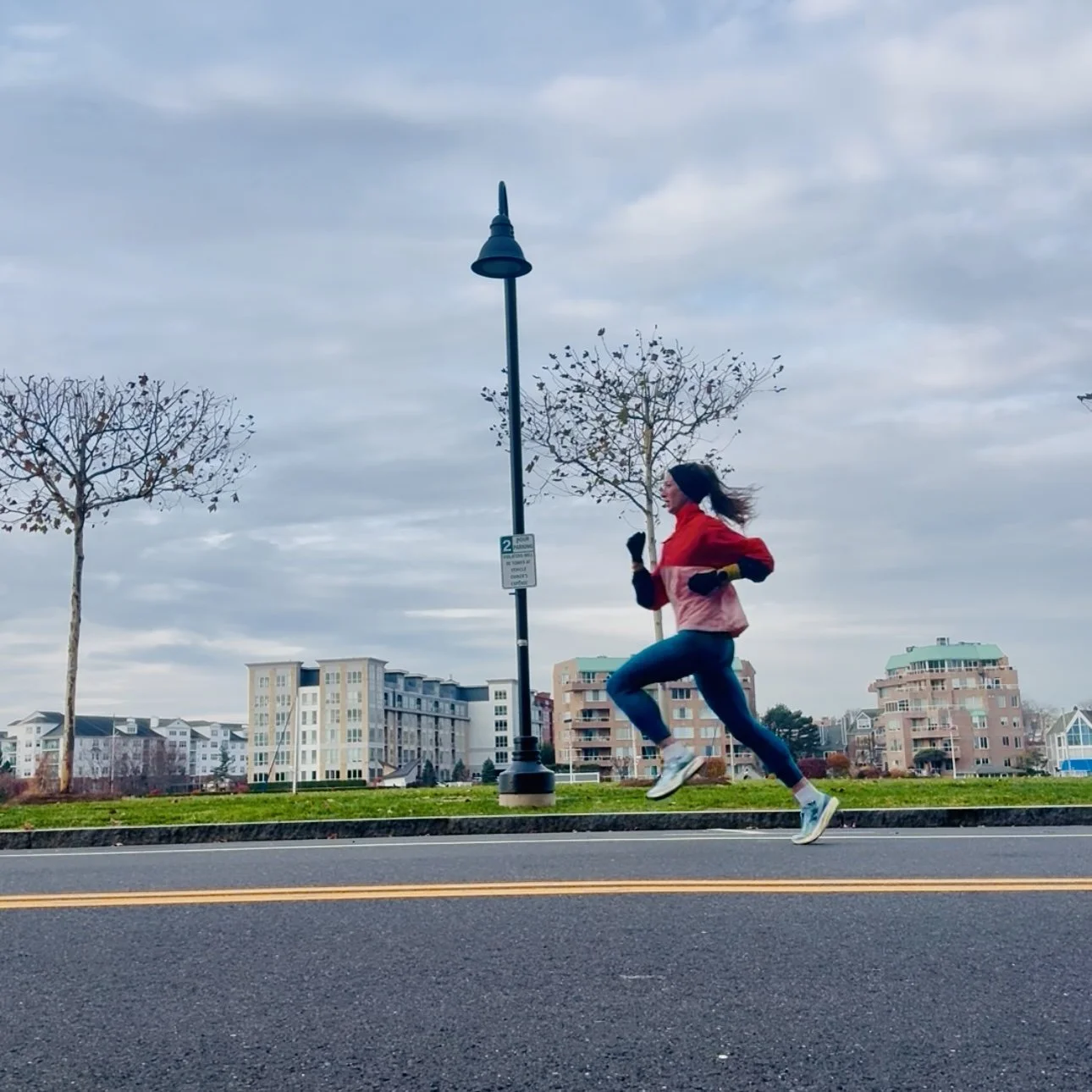
Your mile and 5K often reveal what's possible. The marathon is usually the last distance to catch up.
During marathon training, aerobic development is important, but so are fueling and hydration, learning what works for your body, pacing, understanding how you tolerate different weather and environmental conditions, mental resilience, long-run and time-on-feet adaptations! These are things you simply don't get from 5K-specific training alone. So yes, someone may have the mile speed required for a sub-4-hour marathon and still struggle to run one. The opposite can also be true! Another runner may be able to hold marathon pace exceptionally well, outperform their VDOT prediction, and not be particularly strong at the mile. I often see runners whose mile times are already faster than what the VDOT chart suggests for their marathon goal. It simply means they need to keep building their aerobic engine, improve their ability to handle the distance, become more durable, and spend more time on their feet during a marathon buildup when the time comes.

VDOT Race Predictor
What Should You Focus On Instead?
If your speed already supports your marathon goal, Focus on:
✅ Weekly consistency
✅ Aerobic development
✅ Marathon-specific workouts
✅ Long runs
✅ Fueling
✅ Hydration
✅ Recovery
✅ Staying healthy
Not chasing another random speed workout from Instagram!
Final Thoughts
It took me three years to break three hours in the marathon. It didn't happen overnight!
It wasn't linear.
It required patience, consistency, and trusting the process. The same is true for nearly every marathon runner I coach. If your shorter-distance performances suggest you have the speed to reach your marathon goal, don't become discouraged if the marathon hasn't caught up yet!
Keep building the aerobic engine. Keep showing up. Keep practicing your fueling. Keep developing durability. And most importantly, keep your training FUN! Your marathon is often the last race to reflect all of those fitness gains.
Want More Free Running Tips?
Join our FREE RunWithAlli Discord community where I share weekly:
Training tips
Nutrition guidance
Recovery strategies
Strength workouts
Live Q&As
Running discussions with athletes from around the world
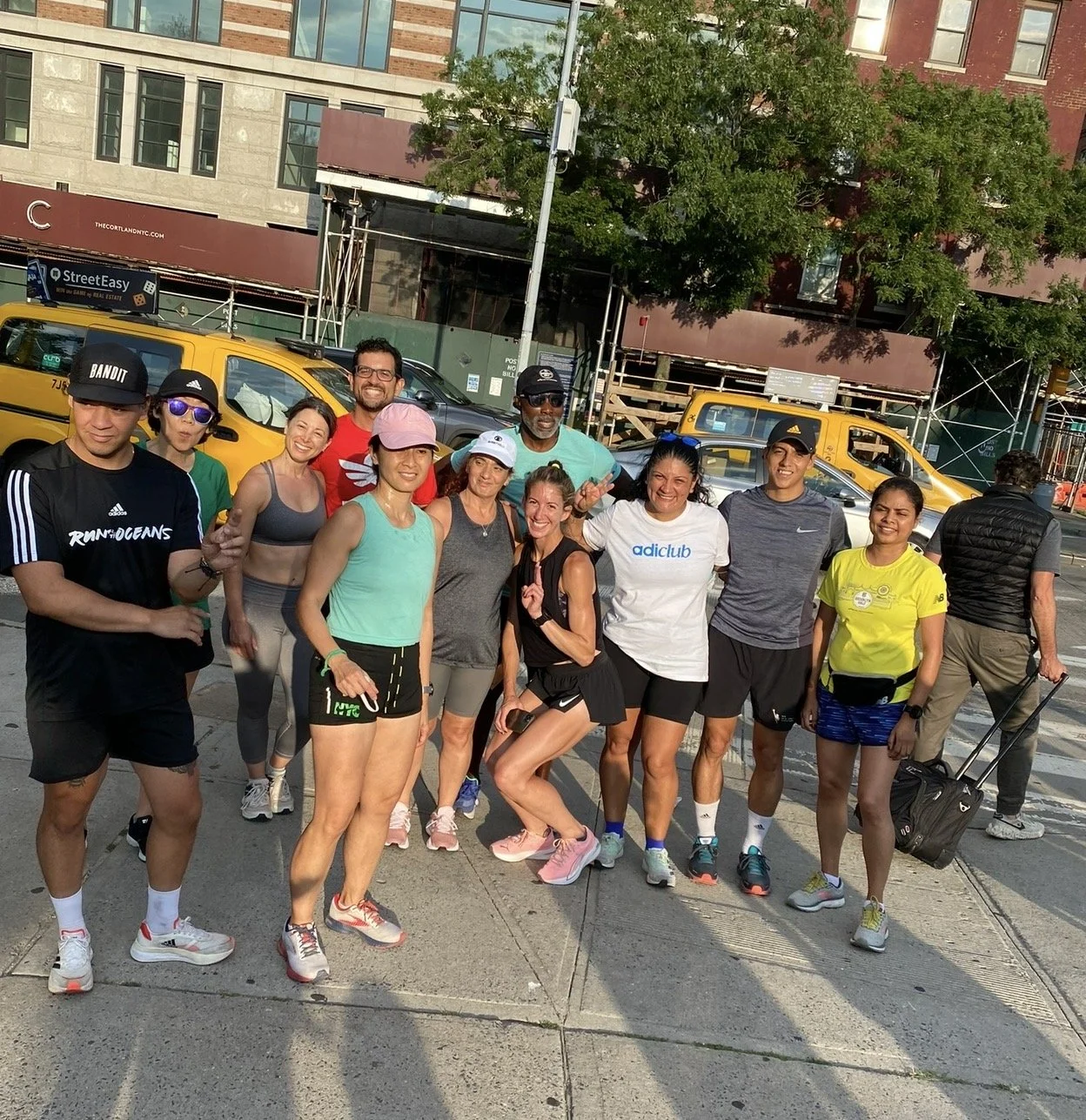
Looking for Personalized Coaching?
If you're ready to stop guessing and start training with a plan built specifically for YOU, we’d love to help!